
Technology Report
October 15, 2026
StarGate
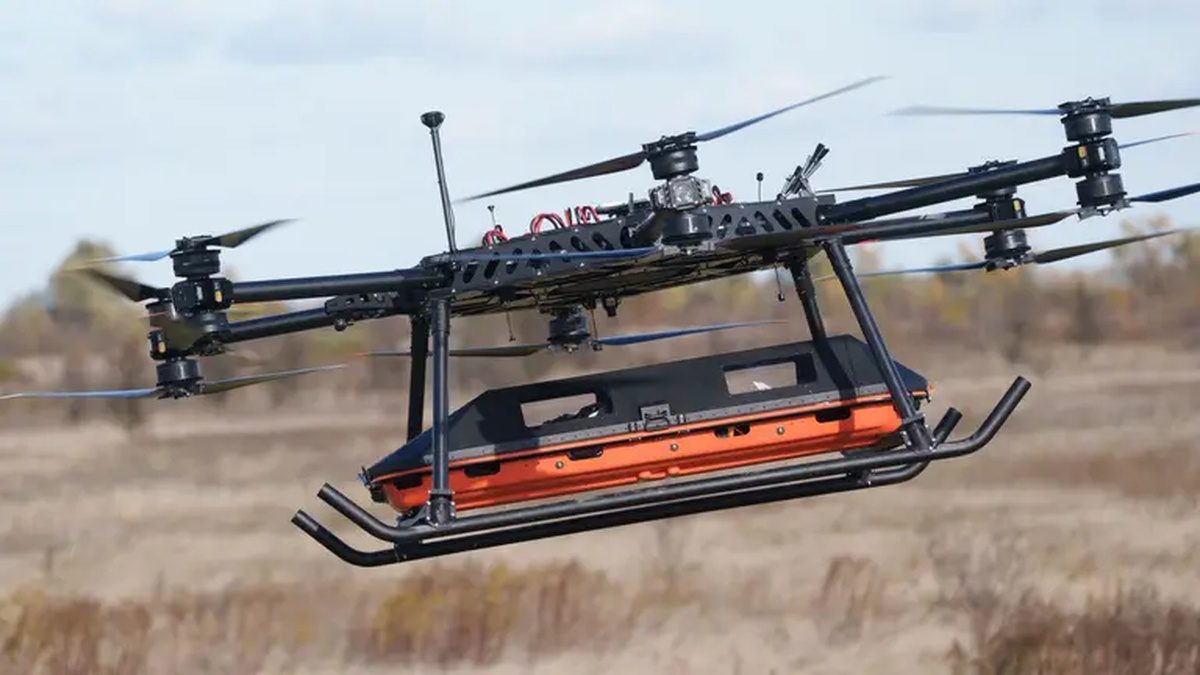
The hardest leg of a battlefield rescue in Ukraine is often the first one: getting a wounded soldier out of a front-line position that vehicles can no longer reach safely. On October 15, 2026, the Associated Press reported from a field demonstration of StarGate, a six-rotor drone built by the Ukrainian manufacturer SkyFall to fly that leg with the casualty on a stretcher and no evacuation crew aboard. The same week, the company handed it to the 475th Separate Assault Regiment, known as Code 9.2, for evaluation under front-line conditions.
What is new is the cargo. Drones already deliver supplies, and ground robots have taken on a growing share of casualty evacuation in Ukraine. Casualty evacuation, or casevac, is the military term for moving a wounded person from where they were hurt to the first point of care. StarGate is built to carry the person, through the air. AP called it Ukraine’s first aerial drone for evacuating wounded soldiers. SkyFall has not published results from flights with a casualty aboard, and the regiment testing it says it is too early to judge.
The request came from the front. Last year, according to AP, the commander of Code 9.2, who goes by the call sign Flint, asked SkyFall’s founder for a safer way to get wounded troops out of hard-to-reach positions. In some sectors the zone under constant drone and artillery threat stretches 10 to 15 kilometers (6 to 9 miles) or farther. Vehicles moving through it are targets, so soldiers sometimes go in on foot. Ground robots struggle with mud, craters, and broken roads, rivers and mines can stop them outright, and they typically need two to three hours to reach a position, said a Code 9.2 commander identified as KVN. “Covering 10 kilometers in minutes would be a drastic change on the front line,” he told AP.
The numbers are the company’s. SkyFall says StarGate can lift up to 150 kilograms (330 pounds), enough for a soldier in body armor with combat gear, and that its enclosed compartment is built around a certified medical stretcher that a wounded soldier can climb into without help. The team stays in contact with the casualty during the flight, the company says. Cruising speed is listed at 65 kilometers per hour (40 mph), with a top speed of 105 kilometers per hour (65 mph). AP reported a one-way range of 15 kilometers, and SkyFall’s own October 17 release gives a flight range of up to 30 kilometers. Getting it ready to fly takes about 10 minutes, and the arms detach for transport. Optical and thermal cameras let it work at night, and SkyFall says it is designed for rain and snow.
A pilot flies it by hand. Control runs over two links: Starlink satellite internet and L-Link, a radio system SkyFall developed itself, so losing one does not cut the aircraft off. An onboard AI system is meant to keep it under control when GPS is jammed or spoofed, meaning drowned out or replaced with false signals. If both links drop, the company says the drone can plot its own route back to a safe area. SkyFall also says StarGate has kept flying after losing one of its arms. AP noted that the company has not provided data on how reliably it survives damage in combat.
Because the aircraft is flying into contested airspace, it carries its own defenses. SkyFall says an onboard jammer suppresses the video feed of attacking FPV drones, the small first-person-view aircraft a remote pilot steers through a camera. For threats that get close, automatic net launchers fire when an AI system, reading cameras, radar, and acoustic sensors, decides the moment is right. In the demonstration AP watched, a net snared an incoming drone and knocked it off course.
None of that is proven in service yet. KVN said his unit needs at least a month with the drone before it can offer meaningful numbers on how often it succeeds. “It’s a completely new method of evacuation,” he said. “It’s difficult to talk in depth about the pros and cons right now. We need to work with it more.” SkyFall confirmed the evaluation but declined to share results. In its release two days later, the company said StarGate had gone on combat duty with Code 9.2 and that its training academy had begun teaching operators.
SkyFall puts the price at $50,000 or more per system, depending on configuration, and says it aims to build up to 1,000 a month by the end of 2026. That is a target, not a delivery record. The company was founded after Russia’s full-scale invasion in 2022 and also makes the Vampire heavy-lift drone, Shrike FPV drones, and the P1-SUN interceptor. Forbes Ukraine and LB.ua also reported the debut.